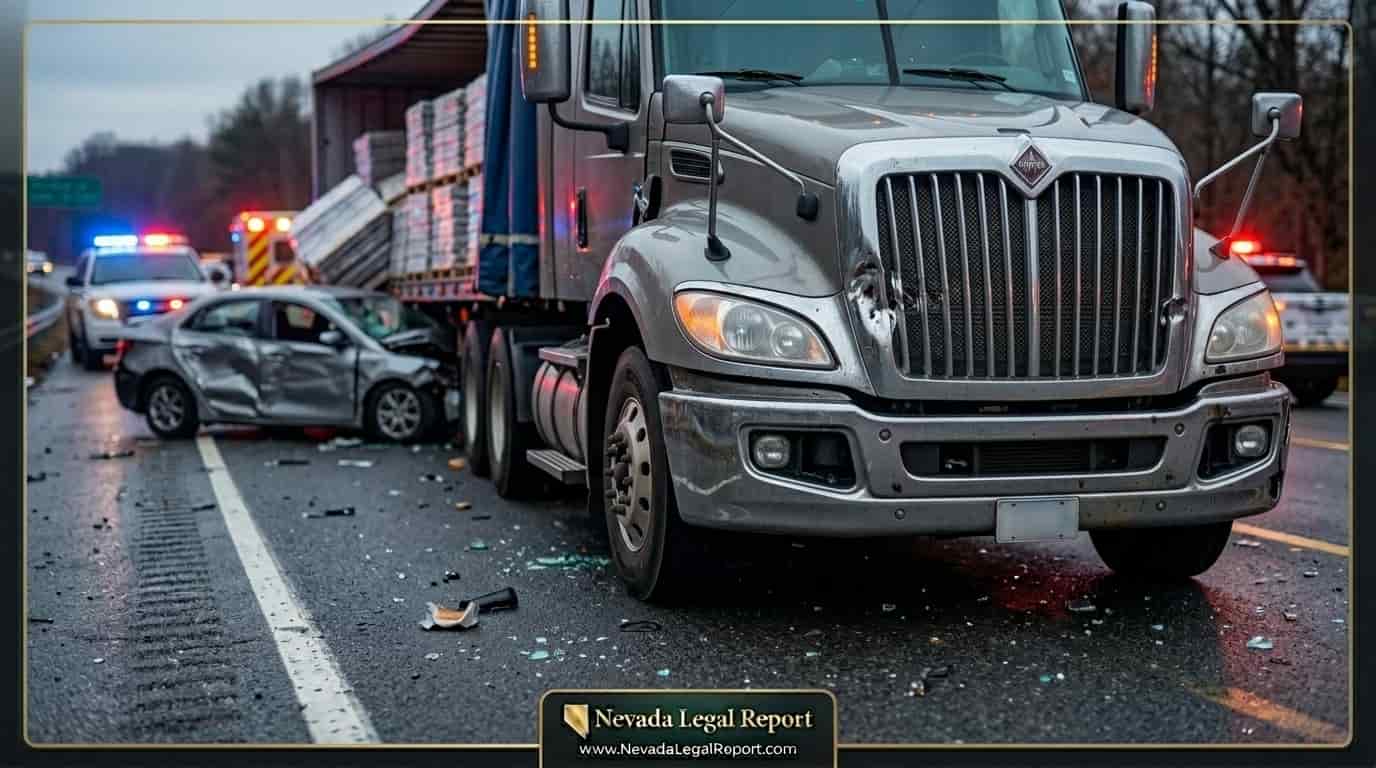
According to the Las Vegas Metropolitan Police Department, a fatal tractor-trailer versus pedestrian collision occurred on the afternoon of April 6th at 7251 South Eastern Avenue, near East Warm Springs Road and South Maryland Parkway in the southeast Las Vegas valley. Evidence at the scene and video surveillance indicated that a male pedestrian, approximately 40 years of age, had crawled under a trailer parked in a loading bay on the west side of the business.
A 57-year-old driver, identified as Joseph Johnston of Las Vegas, connected a 2020 Kenworth 310 tractor unit to the trailer, exited to prepare the trailer for movement, then reentered and pulled forward at which point the trailer tires ran over the pedestrian, who had remained underneath. Medical personnel pronounced the pedestrian deceased at the scene. The Las Vegas Metropolitan Police Department’s Collision Investigation Section is handling the investigation.
These reported facts raise several questions a Nevada personal injury or wrongful death lawyer would want to examine closely, including the driver’s knowledge of the pedestrian’s presence, visibility conditions within the loading bay, and whether applicable commercial motor vehicle standards may have required additional pre-departure checks. Nevada follows a modified comparative negligence rule, and the pedestrian’s decision to position himself under the trailer may be raised as a factor, though a lawyer would assess how that issue interacts with the duty of care owed by the driver and any owning or operating commercial entity. The collision remains under investigation, and final fault findings may depend on the full Metro report and preserved video.
Read the original report here.
Reported Details and What They May Mean for a Claim
- Crash type and location: Tractor-trailer versus pedestrian; 7251 South Eastern Avenue near East Warm Springs Road and South Maryland Parkway, in the southeast Las Vegas valley near Sunset Park
- Pedestrian’s position: According to LVMPD, the male pedestrian had crawled under a parked trailer in a loading bay on the west side of the business prior to the crash
- Driver’s actions: Driver Joseph Johnston, 57, exited the tractor, prepared the trailer for movement, reentered the cab, and then pulled forward; no citations or charges are mentioned in the official report
- Vehicle involved: 2020 Kenworth 310 Cab-Over Engine tractor unit connected to the trailer
- Fatality: The 40-year-old male pedestrian sustained mortal injuries and was pronounced deceased at the scene; a fatal number has not yet been assigned pending state and federal review
- Commercial vehicle involvement: The crash involved a commercial tractor-trailer operating at a business loading bay; no rideshare, DUI arrest, or criminal charges are reported
- Surveillance footage: Video surveillance is noted as part of the evidence reviewed; the incident remains under active investigation by the LVMPD Collision Investigation Section
Based on these reported facts, a lawyer would examine whether the driver conducted an adequate pre-trip inspection or walk-around before moving the vehicle, a practice that federal commercial motor vehicle regulations may require. Because the crash occurred at a business loading bay, questions of premises liability may also arise if the property’s design, access controls, or signage contributed to the pedestrian’s ability to enter the area undetected. These are preliminary observations only; the investigation has not concluded and no fault has been officially assigned.
Key records a lawyer would likely seek in a case like this include the LVMPD crash report and officer diagram, any surveillance footage from the business and surrounding properties, the driver’s commercial driver’s license (CDL) records and employment history with the trucking company, the tractor’s electronic logging device (ELD) or event data recorder (EDR) data, federal inspection and maintenance records for the vehicle, and witness statements from business employees or others present at the scene. Surveillance footage in particular may be critical as video is often overwritten within days, making early preservation efforts a priority.
Legal Issues in Commercial Truck and Loading Bay Crashes Under Nevada Law
Investigators will determine the exact cause of this crash. The following is a general overview of how Nevada law may apply to this type of accident.
Commercial truck crashes, including those occurring in loading bay environments, may involve multiple potentially liable parties beyond the driver alone. Under Nevada law, which may incorporate federal safety regulations through NRS 706.173, a lawyer would examine whether the trucking company, the business operating the loading facility, or other parties bear any responsibility for the incident. Federal Motor Carrier Safety Regulations (49 CFR Parts 350–399) set standards for vehicle operation, pre-trip inspections, and driver conduct. Whether any such standard may apply to the specific circumstances of this crash, including movement within a private commercial loading facility, would be a fact-specific inquiry a lawyer would undertake carefully.
A lawyer would also consider whether the duty of care owed to a pedestrian in a commercial loading environment differs from duties on a public roadway. Under NRS 484B.280, drivers generally owe a duty of care toward pedestrians, though the specific application to a private loading bay would depend on the developed facts. Additionally, a lawyer would examine whether the business owning or operating the loading facility may have had any duty to control access to the area beneath the parked trailers.
Under NRS 41.141, Nevada follows a modified comparative negligence rule. An injured person, or in a fatal case, the surviving family may generally recover so long as the deceased’s fault is not found to be greater than the combined fault of the parties against whom recovery is sought. Any recovery may be reduced by the percentage of fault attributed to the deceased. In this case, the pedestrian’s decision to crawl under the trailer would likely be among the factors examined; however, the outcome of a comparative-fault analysis would depend heavily on the full factual record.
Because this crash resulted in a fatality, a wrongful death claim under NRS 41.085 may be available to the deceased’s heirs potentially including a spouse, children, or parents, depending on the family circumstances. Recoverable damages may include medical expenses incurred before death, funeral and burial costs, lost future income and support, and loss of companionship, subject to the facts and applicable proof requirements. Under NRS 11.190(4)(d), wrongful death claims generally carry a two-year deadline from the date of death. Personal injury claims generally have a two-year deadline under NRS 11.190(4)(e). Missing either deadline may permanently bar recovery, making timely legal review important.
How a Lawyer May Investigate a Fatal Loading Bay Truck Crash in Las Vegas
Serious injury and fatal crashes usually require a fast, thorough legal investigation.
- Obtain the LVMPD crash report and Collision Investigation Section file. This is typically the first priority because it may include the responding officer’s observations, a scene diagram, witness contacts, and any notations regarding video evidence reviewed. In a pending case like this, the full report may take additional time, but a lawyer would initiate the request early.
- Issue a preservation letter for all surveillance footage immediately. LVMPD has noted that video surveillance was among the evidence reviewed. That footage, along with any additional camera angles from adjacent businesses or parking areas, could be overwritten quickly. A lawyer would send a written preservation demand to the business and any neighboring property owners without delay.
- Identify all potentially liable parties. Beyond the driver, a lawyer would investigate the trucking company that owned or operated the tractor-trailer, the business at 7251 South Eastern Avenue, and potentially the property owner, to determine each party’s role, insurance coverage, and possible exposure.
- Request the vehicle’s electronic data and federal records. The 2020 Kenworth 310 tractor unit may contain an event data recorder (EDR) capturing speed, braking, and other pre-crash data. A spoliation letter would typically be sent to preserve this data. Federal inspection records, maintenance logs, and the driver’s CDL history and hours-of-service logs would also be sought.
- Examine federal commercial vehicle regulations for potential violations. Federal Motor Carrier Safety Regulations require commercial drivers to conduct pre-trip inspections and to ensure the area around the vehicle is clear before movement. A lawyer would assess whether the driver’s pre-departure steps met those standards under the reported facts.
- Interview witnesses and business employees. Eyewitness accounts and statements from dock workers, business employees, or others present at the facility at the time of the crash may be important to understanding the sequence of events and the conditions at the loading bay.
A lawyer would use gathered evidence to assess liability across all potentially responsible parties, address any comparative-fault arguments regarding the pedestrian’s position under the trailer, identify available insurance coverage through the trucking company and the business, and document the full scope of damages particularly given the fatal outcome. Commercial vehicle policies often carry higher liability limits than personal auto policies, which may be a significant factor in evaluating the range of potential recovery.
Given the fatality, the primary claim a lawyer would evaluate is wrongful death under NRS 41.085, which may be brought by the deceased’s heirs. Depending on the developed facts, a lawyer may also examine potential negligence claims against the business or property owner for any duty-of-care issues related to the loading facility. No DUI arrest, criminal charges, or conduct described as grossly reckless has been reported by LVMPD at this time, so punitive-damage considerations are not supported by the current record.
What to Know After a Fatal Truck Crash in Nevada
For surviving family members, the immediate priorities after a fatal crash include preserving all available documentation, photos of the scene, any communications from the business or trucking company, and contact information for witnesses. Family members should avoid giving recorded statements to insurance adjusters or company representatives before consulting with a lawyer, as early statements can affect the outcome of a claim.
Nevada’s statute of limitations means that surviving family members may have limited time to file a wrongful death claim, generally two years from the date of death under NRS 11.190(4)(d). An attorney may help identify all potentially liable parties, send preservation notices for critical evidence such as surveillance footage and vehicle data, and evaluate available insurance coverage through the commercial carrier and business involved. Acting early can help prevent the loss of evidence that may not be recoverable later.
Fatal commercial truck crashes can result in significant economic losses for surviving family members, including loss of financial support, loss of companionship, and the costs of final medical care and burial. Fully documenting these losses from the date of the crash forward may be important to any claim for compensation under Nevada law.
Seeking Legal Help After a Las Vegas Commercial Truck Crash
People who have lost a family member in a commercial vehicle crash in Las Vegas or Clark County may have legal options worth evaluating, particularly when the incident involves a tractor-trailer operating in a commercial loading environment and multiple potentially responsible parties. The specific circumstances of this crash, including the loading bay setting, commercial driver involvement, federal regulatory standards, and the business premises, may create a more complex liability picture than a typical roadway accident.
If you or a family member were affected by a similar incident in the Las Vegas area, evidence including surveillance footage, federal vehicle records, the official crash report, and electronic data from the truck may be time-sensitive. Speaking with a qualified Nevada personal injury attorney may be an important early step, given both evidence-preservation deadlines and the statute of limitations under Nevada law.
The information in this article reflects laws and facts reported as of the date of publication. Nevada law may change. This article is for general informational purposes only and does not constitute legal advice. No attorney-client relationship is created by reading or sharing this content. If you have been injured in an accident, consult a qualified Nevada attorney for advice specific to your situation.