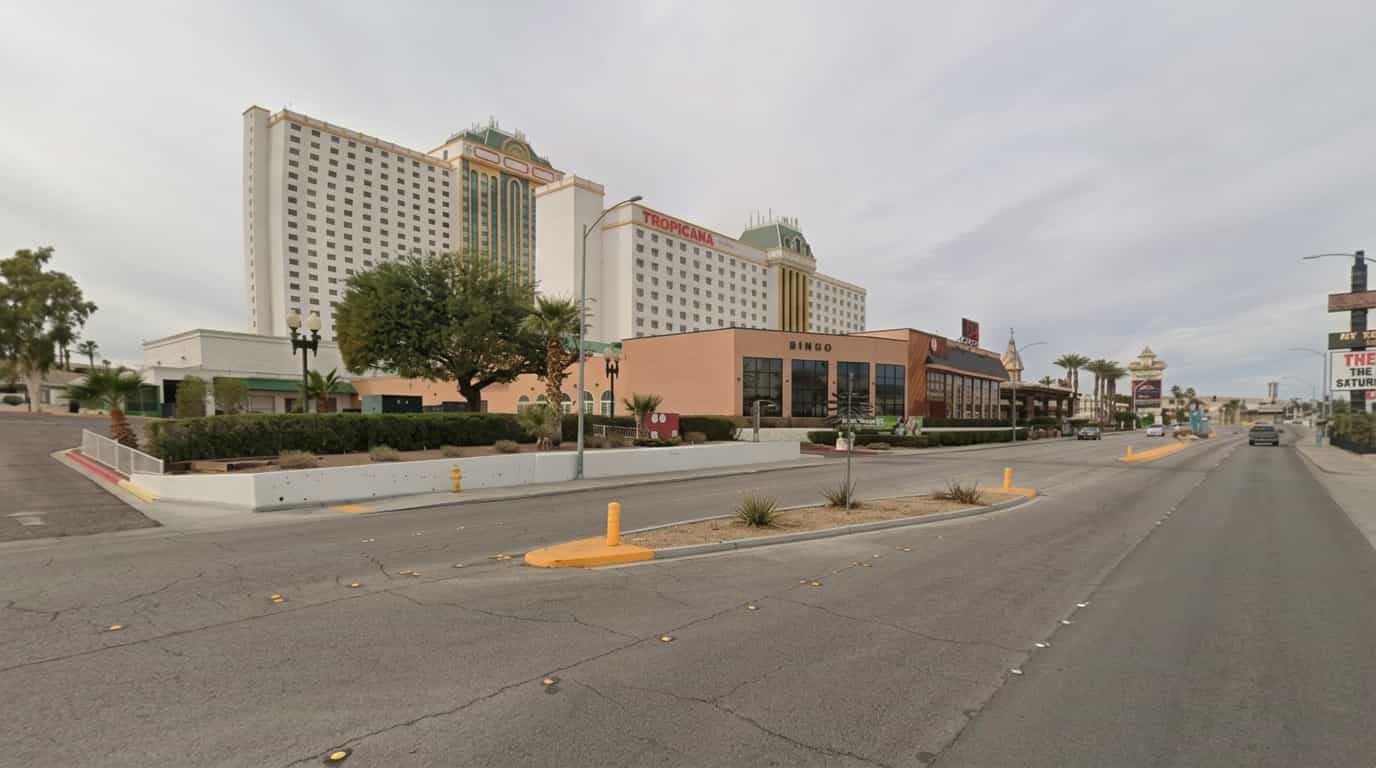
According to the Las Vegas Metropolitan Police Department, a fatal vehicle-versus-pedestrian collision occurred on the afternoon of April 19, 2026, at the intersection of South Casino Drive and Tropicana Drive in Laughlin, Nevada. The crash, which took place in front of the Tropicana Hotel, resulted in the death of an 82-year-old male pedestrian from Roselle, Illinois, and marks the 40th traffic-related fatality in LVMPD’s jurisdiction for 2026. The driver of the involved vehicle, a 2018 Jeep Grand Cherokee, remained at the scene and showed no signs of impairment, according to police.
The reported facts raise several legal questions worth examining including how Nevada’s modified comparative negligence rule may apply when a pedestrian is struck outside a marked crosswalk, what wrongful death claims may be available to surviving family members, and what evidence may be critical to a legal evaluation. The collision remains under investigation, and final fault findings may depend on the full Metro report and preserved video.
Read the original report here.
Reported Details and What They May Mean for a Claim
- A vehicle-versus-pedestrian collision occurred on the afternoon of April 19, 2026, at South Casino Drive and Tropicana Drive in Laughlin, Nevada.
- The pedestrian, an 82-year-old male from Roselle, Illinois, was crossing South Casino Drive from west to east, north of a marked crosswalk, according to LVMPD.
- A 2018 Jeep Grand Cherokee, traveling southbound in the left lane of two travel lanes, made contact with the pedestrian when the front right of the vehicle struck him.
- Emergency personnel transported the pedestrian to Western Arizona Regional Medical Center, where he was pronounced deceased despite life-saving efforts.
- The driver, Richard Salecki, 80, of Golden Valley, Arizona, stopped his vehicle in a controlled manner just south of the collision and showed no signs of impairment.
- Video surveillance and witness statements were noted as part of the evidence at the scene, according to the LVMPD report.
- No citations or arrests were reported; the collision remains under investigation by LVMPD’s Collision Investigation Section.
These reported facts introduce a complex liability picture. A lawyer would examine whether the pedestrian’s position north of the marked crosswalk may be treated as a contributing factor under Nevada law, and whether the driver may have had any opportunity to observe and react to the pedestrian before impact. The involvement of an out-of-state pedestrian and an out-of-state driver may also raise questions about applicable insurance policies and coverage, which a lawyer would review carefully. Preliminary news reports may not contain final police findings. A lawyer would seek the official Las Vegas Metro crash report for more complete details.
Key records that a lawyer would likely seek include the official LVMPD crash report, 911 and dispatch recordings, scene photographs and vehicle damage documentation, traffic camera footage, nearby business surveillance video (particularly given the casino proximity), witness statements, and the pedestrian’s medical records from Western Arizona Regional Medical Center. Preserving surveillance footage from the casino and surrounding businesses is especially time-sensitive, as such recordings are frequently overwritten within days.
Legal Issues in Pedestrian Crash Cases Under Nevada Law
Investigators will determine the exact cause of this crash. The following is a general overview of how Nevada law may apply to this type of accident.
Drivers in Nevada generally owe a duty of due care toward pedestrians under NRS 484B.280, which may require them to exercise caution and reduce speed when a pedestrian is observed even in areas outside a marked crosswalk. At the same time, pedestrians crossing outside a marked crosswalk have their own legal duties under NRS 484B.287, which generally requires pedestrians to yield the right-of-way to vehicles when crossing at points other than a marked crosswalk. A lawyer would carefully examine both the driver’s conduct and the pedestrian’s position relative to the crosswalk and the vehicle’s travel lane, as both may be relevant to the comparative fault analysis.
According to a review of Nevada’s jaywalking statute, even when a pedestrian crosses outside a crosswalk, a driver who failed to exercise due care may still bear partial or majority fault depending on the facts. The applicable standard does not automatically assign all fault to the pedestrian simply because the crossing occurred north of a marked crosswalk. A lawyer would examine the specific timing, visibility conditions, vehicle speed, and lane position to evaluate how fault may be allocated under the reported facts.
Nevada follows a modified comparative negligence rule under NRS 41.141. Generally, an injured person, or their surviving family members in a wrongful death claim, may pursue recovery as long as the decedent’s negligence is not greater than the negligence of the party or parties against whom recovery is sought. Any recovery may be reduced by the decedent’s percentage of fault. In a case where a pedestrian was crossing outside a marked crosswalk, comparative fault arguments are likely to arise, and a lawyer would work to develop the full evidentiary record before any fault allocation is made.
Because the pedestrian died as a result of this collision, surviving family members may have the right to pursue a wrongful death claim under NRS 41.085. Eligible claimants may include a spouse, children, or parents depending on the family’s circumstances. Recoverable damages in a wrongful death claim may include medical expenses incurred before death, funeral and burial costs, lost future income and support, and loss of companionship, depending on the claim structure and proof. The statute of limitations for wrongful death claims may be two years from the date of death under NRS 11.190(4)(d), making timely legal review important.
The involvement of an out-of-state pedestrian and an out-of-state driver is also a factor a lawyer would note. A lawyer would review all auto insurance policies that may apply, including the driver’s own liability coverage and any underinsured or uninsured motorist coverage the pedestrian’s family may hold through household policies, to identify available sources of recovery.
How a Lawyer May Investigate This Type of Fatal Pedestrian Crash
Serious injury and fatal crashes usually require a fast, thorough legal investigation.
- Obtain the official LVMPD crash report. This report is often the first priority because it may contain the responding officer’s observations, a scene diagram, witness contact information, and any citations or findings. The Collision Investigation Section’s full report may be more detailed than the initial press release.
- Preserve surveillance and traffic camera footage immediately. The crash occurred in front of the Tropicana Hotel on a casino corridor with high camera density. Footage from the hotel, adjacent businesses, and traffic cameras may show the pedestrian’s exact path, the vehicle’s speed and lane position, and the sequence of events but this footage is often overwritten within days. A preservation letter should be sent quickly.
- Identify and interview witnesses promptly. The LVMPD report notes that witness statements were gathered at the scene. A lawyer would follow up with those witnesses early, as memory fades and witnesses may become difficult to locate over time.
- Collect vehicle event data recorder (EDR) information. The 2018 Jeep Grand Cherokee may have an EDR that recorded speed, braking, and steering input in the seconds before the collision. A spoliation letter should be sent to preserve this data before the vehicle is repaired or transferred.
- Retain an accident reconstruction expert if warranted. In cases where the pedestrian’s exact position relative to the crosswalk, the vehicle’s lane, and the point of impact are disputed, an expert may analyze the physical evidence, surveillance footage, and vehicle damage to help reconstruct the sequence of events.
- Review all applicable insurance policies. A lawyer would identify the driver’s liability coverage, any umbrella or household policies, and any UM/UIM coverage held by the pedestrian’s family that may apply if liability coverage is contested or insufficient.
Evidence gathered through this investigation may help establish how the collision occurred, address comparative fault arguments that are likely to arise given the pedestrian’s reported position outside the marked crosswalk, and document the full extent of damages for the family’s wrongful death claim. The existence of video surveillance specifically noted in the LVMPD release may be particularly significant to the liability evaluation.
Potential claims in this matter may include wrongful death under NRS 41.085 on behalf of the pedestrian’s surviving family members, along with claims for pre-death pain and suffering and related expenses. Because no impairment or criminal conduct was reported, the focus of any civil case would likely center on negligence and comparative fault under NRS 41.141.
What Surviving Family Members Should Know
When a family member is killed in a pedestrian crash, the immediate priority is ensuring that all potential evidence is preserved and that a legal evaluation begins promptly. Families should avoid giving recorded statements to insurance adjusters before speaking with an attorney, as early statements may be used to frame the comparative fault analysis before the full facts are known. Documenting the circumstances, including reviewing any available news or social media coverage of the crash, may also be helpful in the early stages.
Nevada’s statute of limitations means that wrongful death claims may have a two-year deadline from the date of death under NRS 11.190(4)(d). Missing that deadline may permanently bar the claim. An attorney may help identify potentially liable parties, evaluate available insurance coverage, and preserve critical evidence, including casino and traffic surveillance footage, before it is lost. Acting early is particularly important in cases like this one, where video evidence may already be at risk of being overwritten.
Serious crashes often result in significant financial and personal loss for surviving family members. Documenting all losses, including funeral expenses, the decedent’s projected income and support contributions, and the family’s loss of companionship, from the date of the crash forward may be important to the full value of any wrongful death claim.
Nevada Personal Injury and Wrongful Death Legal Resources
Surviving family members of pedestrians killed in Nevada vehicle accidents may have legal options worth evaluating, even when the pedestrian was crossing outside a marked crosswalk. Nevada’s comparative negligence framework means that a pedestrian’s comparative fault, if any, does not automatically bar a claim; it may only reduce the amount of any recovery depending on how fault is allocated. In a case like this one, where the driver showed no signs of impairment and stopped at the scene, a lawyer would closely analyze the road conditions, visibility, vehicle speed, and the pedestrian’s exact path to evaluate what claims may be viable.
If you or a family member were involved in a similar accident in Las Vegas, Laughlin, or Clark County, Nevada law may allow the pursuit of a wrongful death or personal injury claim. Evidence, including surveillance footage, the official crash report, and witness statements, can disappear quickly. Speaking with a qualified Nevada personal injury attorney may be an important early step.
The information in this article reflects laws and facts reported as of the date of publication. Nevada law may change. This article is for general informational purposes only and does not constitute legal advice. No attorney-client relationship is created by reading or sharing this content. If you have been injured in an accident, consult a qualified Nevada attorney for advice specific to your situation.