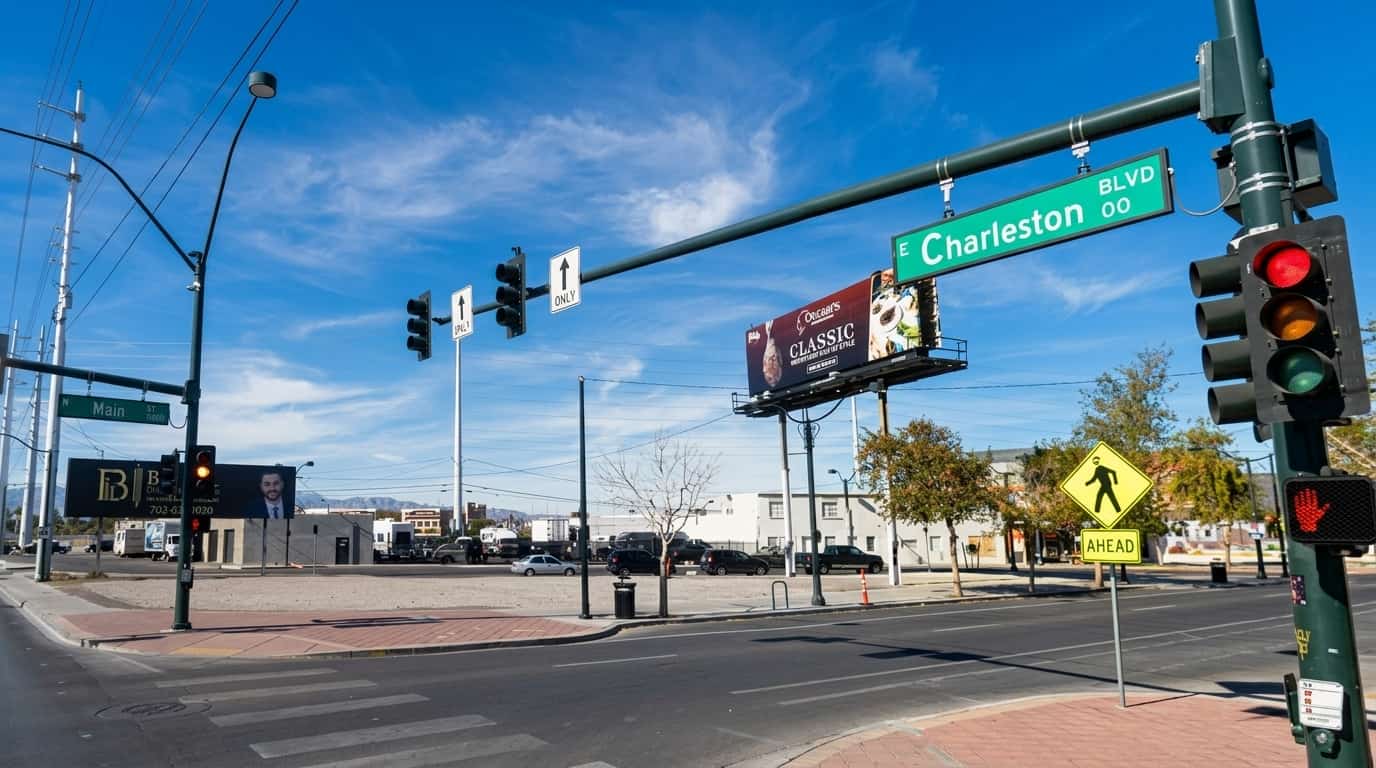
On the night of August 4th, 2026, a vehicle versus pedestrian and vehicle collision occurred on East Charleston Boulevard east of South Main Street in Las Vegas, near the Arts District. According to the Las Vegas Metropolitan Police Department, a 2024 Mercedes-Benz EQS was stopped at a red light behind a 2023 Chevrolet Suburban when, for an unknown reason, the Mercedes-Benz accelerated forward and struck a pedestrian crossing between the two stopped vehicles, trapping him against the Chevrolet. The pedestrian, a 27-year-old man from Winter Park, Florida, was transported to University Medical Center’s Trauma Unit with life-threatening injuries. The driver of the Mercedes-Benz remained at the scene and did not show signs of impairment.
Based on these reported facts, a lawyer would examine the conduct of the Mercedes-Benz driver, the reason the vehicle accelerated from a stopped position, and the availability of liability coverage for a seriously injured out-of-state visitor. Nevada follows a modified comparative negligence rule, which generally means an injured person may recover damages if his or her fault is not greater than the combined fault of the parties sued, though any recovery may be reduced by the person’s percentage of fault. The collision remains under investigation, and final fault findings may depend on the full Metro report and preserved video.
Reported Details and What They May Mean for a Claim
- The collision occurred at approximately 10:33 p.m. on August 4th on East Charleston Boulevard east of South Main Street, in a westbound queue of vehicles stopped at a red light.
- The pedestrian was crossing Charleston Boulevard north to south, east of the intersection, outside of a marked or implied crosswalk, passing between the stopped Chevrolet Suburban and the stopped Mercedes-Benz EQS.
- For an unknown reason, the Mercedes-Benz accelerated forward, struck the pedestrian, and trapped him between the two vehicles.
- The pedestrian was admitted to UMC’s Trauma Unit with life-threatening injuries.
- The Mercedes-Benz driver, a 66-year-old Las Vegas man, remained at the scene and did not show signs of impairment.
- A 55-year-old passenger in the Chevrolet Suburban claimed injury, while the Suburban’s driver and a second passenger reported no injuries.
- The pedestrian is a resident of Winter Park, Florida, making this a case involving an out-of-state injured person.
- Metro cited evidence at the scene, video surveillance, and witness statements as the basis for its preliminary findings.
Preliminary police releases may not contain final investigative findings. A lawyer would seek the full Las Vegas Metro crash report, including any supplemental narratives and reconstruction materials, for more complete details.
These reported facts may indicate several issues worth close review. The unexplained forward acceleration of a stopped vehicle raises questions about driver attention, a possible medical event, or even a vehicle malfunction, each of which points toward a different liability theory. At the same time, the reported mid-block crossing outside a crosswalk may become a comparative fault argument raised by a defense. The claimed injury by the Suburban passenger may also create a second, separate claim arising from the same event.
Key records in a case like this often include the police crash report, 911 and dispatch recordings, scene photographs, vehicle damage diagrams, witness statements, and medical records. Police diagrams may help establish the exact point of impact and the position of the pedestrian between the vehicles, which can matter when fault is disputed. Video surveillance is especially important here because Metro specifically cited it, and business or traffic camera footage near Charleston and Main is often overwritten within days if not preserved quickly.
Legal Issues in a Pedestrian Crash Under Nevada Law
Investigators will determine the exact cause of this crash. The following is a general overview of how Nevada law may apply to this type of accident.
Drivers generally owe a duty of due care toward pedestrians under Nevada law (NRS 484B.280). A lawyer would examine whether the Mercedes-Benz driver may have been distracted, inattentive, or otherwise failed to keep his vehicle stationary while stopped in traffic. The fact that the vehicle moved forward from a full stop at a red light, striking a person directly in front of it, would likely be a central focus of any civil investigation.
Pedestrians also have duties under Nevada law, and crossing outside of a marked or implied crosswalk can become a significant issue. Nevada’s comparative negligence statute (NRS 41.141) may apply if an insurer argues the pedestrian’s decision to cross mid-block, between stopped vehicles and at night, contributed to the collision. A lawyer would evaluate sight lines, lighting conditions, the speed of the acceleration, and whether the pedestrian was visible before the impact, because those facts often determine how fault percentages are argued.
The “unknown reason” for the acceleration is a legally important detail. If distraction is suspected, Nevada’s prohibition on manually typing, sending, or reading text messages while driving (NRS 484B.165) may be relevant, and a lawyer would seek the driver’s cell phone records through subpoena or other appropriate process. If a sudden medical episode or an unintended acceleration defect is raised, the analysis could shift toward medical records or potential product liability issues involving the vehicle manufacturer, depending on the developed facts.
Because the injured pedestrian is an out-of-state resident, a lawyer would also examine jurisdiction and insurance coordination issues. Nevada courts generally have jurisdiction over crashes occurring in Nevada, but the injured person’s own Florida auto policy and any household policies may provide additional coverage, including personal injury protection or uninsured/underinsured motorist benefits, depending on policy language.
Evidence a Lawyer Would Prioritize
Obtaining the police report early is a priority because it may contain witness statements, diagram details, and the responding officer’s observations about the position of the vehicles and the pedestrian. Preserving video footage is critical in this case because Metro stated that surveillance video exists, and footage from businesses along Charleston Boulevard is frequently overwritten within days. A preservation letter sent promptly can make the difference between having and losing the most objective account of the collision.
Vehicle data may also matter. A 2024 Mercedes-Benz EQS is likely equipped with an event data recorder and advanced driver-assistance systems, and a lawyer would examine whether that data shows driver input, sudden acceleration, or a system anomaly before the impact. Witness statements, including those from the Suburban’s occupants who were inches from the collision, may help establish how quickly and forcefully the Mercedes moved forward.
Potential Damages and Insurance Considerations
A pedestrian admitted to a trauma unit with life-threatening injuries may face substantial medical expenses, lost income, rehabilitation costs, and pain and suffering, all of which are categories of damages typically evaluated in a Nevada personal injury law claim. The severity of the reported injuries suggests that available policy limits will be an early and important question. No outcome can be guaranteed, and claim value depends on the developed medical record and the fault findings.
The primary source of recovery would typically be the liability policy covering the Mercedes-Benz and its driver. Because the pedestrian is from Florida, a lawyer would also review his own auto policy and any household member policies for UM/UIM or medical payments coverage that might apply if liability limits are insufficient. The Suburban passenger who claimed injury may have a separate claim against the Mercedes-Benz driver, though a lawyer would examine what that passenger experienced and whether the claimed injuries are documented.
Nevada Statute of Limitations and Practical Next Steps
In Nevada, personal injury claims generally must be filed within two years under NRS 11.190, and missing that deadline can bar recovery entirely. Even though two years may sound like ample time, the practical deadlines for evidence are much shorter, since surveillance footage, vehicle data, and witness memories fade or disappear within days and weeks. For a Las Vegas car accident involving a seriously injured visitor, early preservation of evidence and a careful review of all potentially applicable insurance policies are often the steps that shape the eventual claim.
This article is provided for general informational purposes by Nevada Legal Report and does not constitute legal advice. The collision remains under investigation by the Las Vegas Metropolitan Police Department’s Collision Investigation Section, and the facts described above are based on preliminary reporting from LVMPD and FOX5 Las Vegas.
Leave a Reply