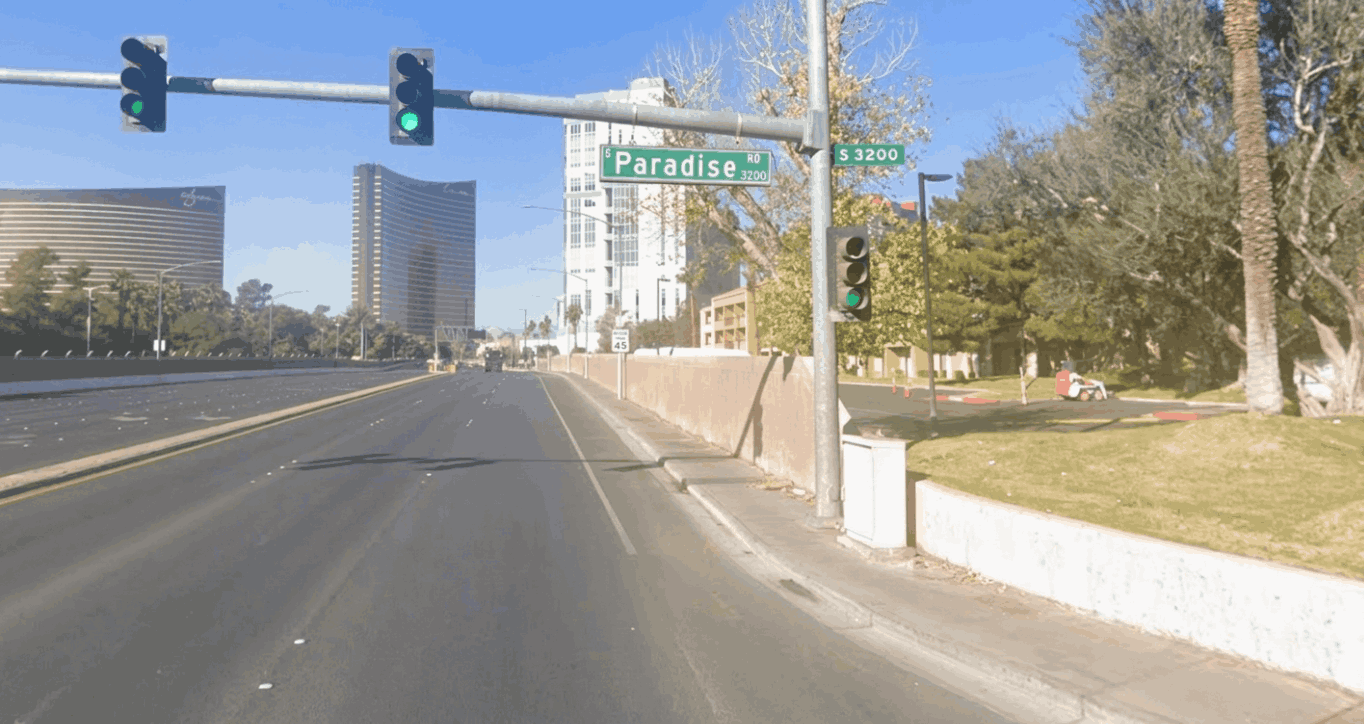
A multi-vehicle collision on August 12, 2026, at the intersection of East Desert Inn Road and Paradise Road in Las Vegas left one driver dead and marked the 73rd traffic-related fatality within the Las Vegas Metropolitan Police Department’s jurisdiction for the year, according to the official LVMPD press release.
What Was Reported at the Scene
According to the LVMPD release. A burgundy 2017 Honda Accord was stopped at a red light, facing westbound on East Desert Inn Road at Paradise Road. A white 2007 Hyundai Sonata traveling westbound struck the rear of the Accord, then drove around it and accelerated through the intersection. The Sonata’s front end then collided with the driver’s side of a white 2022 Honda Civic that was stopped southbound on Paradise.
Emergency crews transported the drivers of the Sonata and the Civic to Sunrise Hospital. The Civic’s driver, a 28-year-old Las Vegas man, later succumbed to his injuries and was pronounced deceased. Police say the Sonata’s driver exhibited signs of impairment and was arrested on suspicion of DUI.
Additional reporting from the Las Vegas Review-Journal identified the deceased driver as Roy Izquierdo, 28, whose cause of death was listed by the Clark County coroner’s office as blunt force injuries. The Sonata’s driver, identified by police as 60-year-old Daylon Bernstine, was described in the arrest report as driving roughly 30 miles per hour when he rear-ended the Accord “at a relatively low speed,” then accelerating and pushing the Accord aside before continuing through the intersection into Izquierdo’s Civic, ultimately pushing it into a concrete retaining wall. The report also states officers found a bag of a substance consistent with marijuana near Bernstine’s car, noted the smell of burned marijuana, and observed bloodshot eyes and slurred speech. Bernstine reportedly refused field sobriety testing and a blood draw at the hospital, did not have a valid driver’s license at the time of the crash, and has a prior 2012 misdemeanor DUI conviction, according to court records cited by the Review-Journal. He faces two felony charges: DUI resulting in death and reckless driving.
The collision remains under investigation, and final fault findings may depend on the full Metro report and any preserved video or forensic toxicology results.
How a Nevada Lawyer Would Approach Liability
Based on these reported facts, a lawyer would examine whether the Sonata driver’s conduct establishes negligence, and potentially negligence per se, given the reported DUI arrest and felony charges. Nevada law generally treats a driver’s violation of a traffic or DUI statute as evidence that helps establish a breach of the duty of care owed to other motorists, though a formal finding of guilt in the criminal case is separate from civil liability and is not required before a civil claim can proceed.
Rear-end collisions like the initial impact with the Accord often raise following-distance and lookout issues, since a trailing driver generally owes a duty to maintain a safe distance and avoid striking a vehicle stopped at a red light. A lawyer would also examine the second impact, the collision with the Civic, as a potentially separate basis for liability, since the Sonata reportedly continued through the intersection after the first collision rather than stopping.
Because two other vehicles were struck, a lawyer representing either the Accord driver or the family of the Civic driver would look closely at whether any comparative fault issues apply to the other parties, though nothing in the reported facts suggests either stopped vehicle contributed to causing the collisions.
Comparative Negligence and Nevada’s 51% Rule
Nevada follows a modified comparative negligence rule under NRS 41.141. Under this framework, an injured person or a deceased victim’s estate can still recover damages as long as their own share of fault does not exceed 50 percent, with any recovery reduced by that percentage of fault. If a party is found 51 percent or more at fault, that party is barred from recovery entirely. Based on the facts reported so far, including two vehicles that were stopped and not moving at the time they were struck, a lawyer would likely see limited grounds to argue significant comparative fault against either the Accord driver or the Civic driver, though this analysis could shift depending on additional evidence.
Punitive Damages in a Nevada DUI Case
Because this collision reportedly involved a DUI arrest and felony charges, punitive damages may be a consideration in a civil case, depending on later-developed facts. Nevada law includes a DUI-specific punitive damages framework under NRS 42.010 that applies when a defendant caused injury or death while operating a vehicle in violation of Nevada’s DUI statutes. This is a separate and generally lower bar than Nevada’s standard punitive damages statute, which normally requires proof of oppression, fraud, or malice. A lawyer would examine whether the reported blood alcohol level above the legal limit, the reported marijuana odor, and the prior DUI history could support a punitive damages claim, while recognizing that meeting this bar still requires specific proof developed through discovery and, potentially, the outcome of the criminal case.
Wrongful Death Claims Under Nevada Law
Because the Civic driver died from his injuries, Nevada’s wrongful death statute would likely govern any civil claim brought on his behalf. Nevada law allows an estate and certain surviving family members, such as a spouse, children, or parents, to bring separate wrongful death claims. A lawyer would examine who qualifies as an heir under Nevada’s wrongful death framework, what damages may be available, including medical expenses, funeral and burial costs, and loss of the decedent’s financial support and companionship, and how any recovery would be divided among eligible family members.
Insurance Coverage and Underinsured Motorist Claims
A lawyer would also review what auto insurance coverage may be available. Nevada requires drivers to carry minimum liability coverage, but a driver with a lapsed license, a prior DUI conviction, and pending felony charges may carry only minimum limits or, in some cases, face coverage disputes or exclusions depending on the specific policy language. If the at-fault driver’s available liability coverage is insufficient to cover the reported injuries and the death, a lawyer would examine whether underinsured motorist (UIM) coverage on the victims’ own policies, or on a household member’s policy, could provide additional compensation. This is a common consideration in serious injury and fatality cases where the at-fault driver’s coverage limits may not fully address the losses involved.
Evidence That Often Matters in Cases Like This
In a case with these reported facts, evidence commonly gathered by attorneys and investigators includes traffic signal timing data, any nearby traffic or business surveillance footage, the official collision investigation report, toxicology results if a blood sample was ultimately obtained, black box or event data recorder information from the vehicles involved, and witness statements describing the sequence of impacts. Because the reported facts describe two separate collisions within seconds of each other, establishing a clear timeline through this kind of evidence is often central to how a personal injury or wrongful death claim is built.
This article is for informational purposes only and does not constitute legal advice. The facts described are based on official statements and published news reporting available at the time of writing, and details may change as the investigation and any related criminal proceedings continue.
Leave a Reply