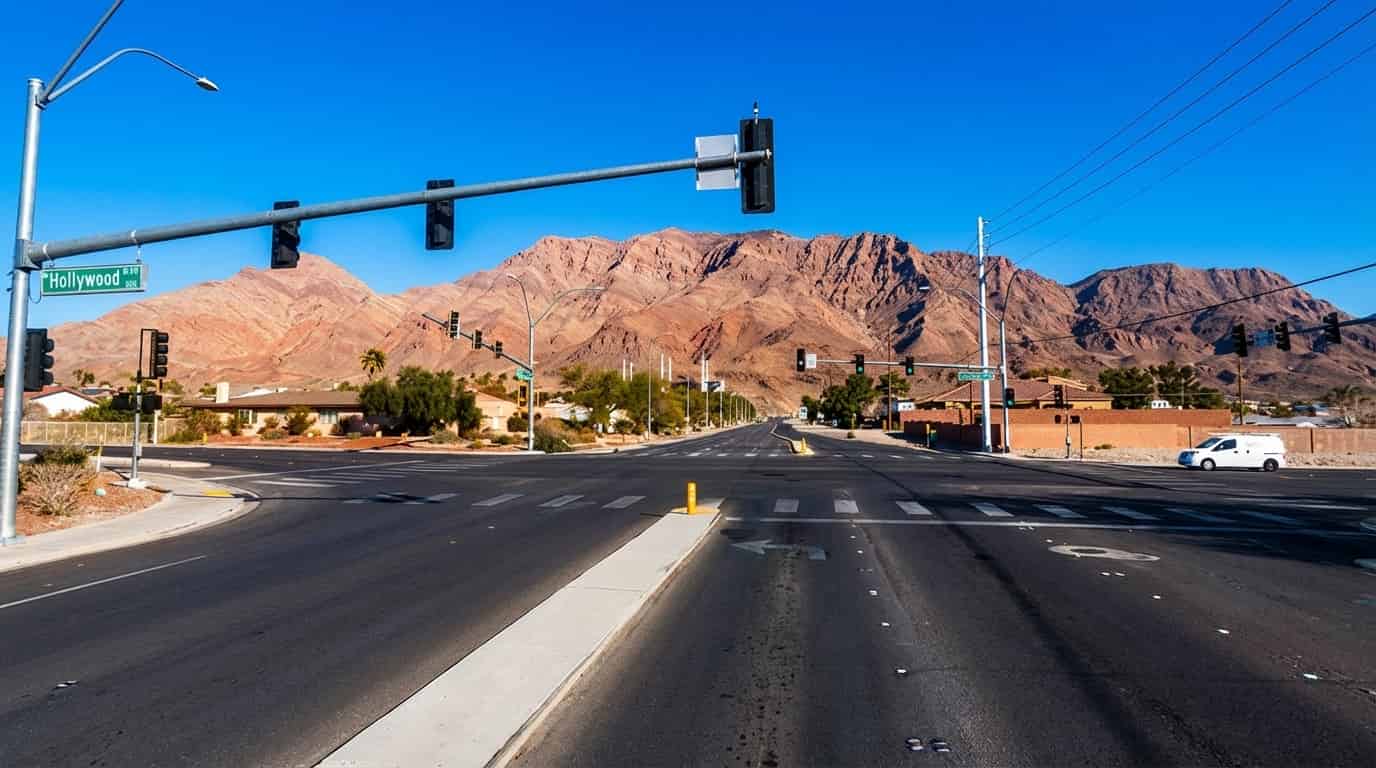
A fatal two-vehicle crash on North Hollywood Boulevard, south of East Bonanza Road, in the east Las Vegas valley resulted in the death of one driver and left two others injured late on April 8th, 2026. According to the Las Vegas Metropolitan Police Department, a 2008 Pontiac Grand Prix was traveling southbound on Hollywood Boulevard at a high rate of speed when the driver lost control, crossed left of center, and struck a northbound 2023 GMC Sierra. The collision caused the GMC to overturn onto its passenger’s side. The driver of the Pontiac, a 23-year-old Las Vegas man, was pronounced deceased at the scene; the driver and passenger of the GMC were transported by ambulance to UMC Trauma with moderate and minor injuries respectively.
From a legal standpoint, the reported facts raise immediate questions about liability, the role of speed as a contributing factor, and available insurance coverage for the injured occupants of the GMC. Nevada follows a modified comparative negligence rule under NRS 41.141, which generally allows an injured person to recover damages as long as their own fault is not greater than the fault of the opposing parties. The collision remains under investigation, and final fault findings may depend on the full Metro report and preserved video.
Reported Details and What They May Mean for a Claim
The following facts are drawn from the official LVMPD press release. Preliminary reports may not contain final police findings; a lawyer would seek the official Las Vegas Metro crash report for complete details.
- A vehicle-versus-vehicle crash occurred on N. Hollywood Boulevard south of E. Bonanza Road in the east Las Vegas valley
- A 2008 Pontiac Grand Prix was traveling southbound at a reported high rate of speed; the driver lost control, rotated counterclockwise, and crossed left of center into northbound lanes
- A 2023 GMC Sierra was traveling northbound; the passenger side of the Pontiac struck the front of the GMC, causing the GMC to overturn onto its passenger’s side
- The driver of the Pontiac (23-year-old male, Las Vegas) was pronounced deceased at the scene; this collision is recorded as the 37th traffic-related fatality in LVMPD’s jurisdiction for 2026
- The driver of the GMC, Jose Soto (20-year-old male, Henderson), sustained moderate injuries; passenger Perla Mondragon (21-year-old female, Las Vegas) sustained minor injuries
- Both GMC occupants were transported by ground ambulance to UMC Trauma
- No citations, arrests, or DUI allegations were reported in the official release; the crash remains under investigation by LVMPD’s Collision Investigation Section
These reported facts may be significant for evaluating liability. The described loss of control at a high rate of speed and the crossing of the center line are factors that a lawyer would examine closely when assessing fault. A lawyer would also consider whether the late-night conditions, road characteristics at the Hollywood-Bonanza intersection, and vehicle speed all contributed to how the crash unfolded. Because no official fault determination has yet been made, all legal analysis at this stage remains preliminary and subject to revision as the investigation proceeds.
Key records and evidence that a lawyer would seek in a case like this include: the official LVMPD crash report and diagram, 911 and dispatch recordings, scene photographs, vehicle damage assessments, witness statements, medical records from UMC Trauma, and traffic or intersection camera footage. The LVMPD press release notes that witness statements were part of the initial evidence gathered. The Hollywood-Bonanza intersection in east Las Vegas may be covered by RTC FASTCam or similar traffic monitoring cameras, and footage from those systems can be critical but it is often overwritten within days, making prompt action essential. The Event Data Recorder (EDR or “black box”) in both vehicles may also contain pre-crash speed, braking, and steering data that could prove important to the liability analysis.
Legal Issues in Vehicle-Versus-Vehicle Crashes Under Nevada Law
Investigators will determine the exact cause of this crash. The following is a general overview of how Nevada law applies to this type of accident.
When a driver loses control, crosses the center line, and collides with oncoming traffic, a lawyer would examine whether that conduct constitutes a violation of applicable Nevada traffic laws. Traveling at a high rate of speed and departing from the proper lane of travel are behaviors that may be relevant to a negligence analysis. A lawyer would review whether any traffic citations were ultimately issued and what the official crash diagram indicates about vehicle positions and points of impact.
Because this crash resulted in a fatality, the family of the deceased driver may have standing to assert a wrongful death claim under NRS 41.085, depending on the specific facts and fault apportionment. At the same time, the surviving occupants of the GMC, Jose Soto and Perla Mondragon, may have personal injury claims based on the reported facts. A lawyer would evaluate which parties may bear legal responsibility and what insurance coverage is available to address those claims.
Nevada’s modified comparative negligence framework under NRS 41.141 means that fault is not necessarily all-or-nothing. Under this rule, an injured person may recover compensation as long as their own negligence is not greater than the negligence of the parties against whom recovery is sought, with any recovery reduced proportionally by the injured person’s share of fault. In a crash like this, where one vehicle appears to have crossed into oncoming lanes, the comparative fault question may primarily focus on the Pontiac’s driver; however, a thorough legal review would examine the conduct of all parties.
Regarding the statute of limitations, personal injury claims arising from Nevada car accidents generally must be filed within two years of the crash date under NRS 11.190(4)(e). Wrongful death claims carry the same two-year deadline under NRS 11.190(4)(d). Missing this deadline permanently bars the claim, making early legal consultation important.
How a Lawyer Investigates a Fatal Cross-Center-Line Crash in Las Vegas
Serious injury and fatal crashes usually require a fast, thorough legal investigation.
- Obtain the official LVMPD crash report. This is typically the first priority. The report will contain the responding officer’s observations, a scene diagram showing the vehicles’ paths and point of impact, witness contact information, and any citations or notations about suspected contributing factors. Under Nevada law, crash reports are typically available within 10 to 14 days.
- Preserve traffic camera and surveillance footage immediately. RTC FASTCam images have already appeared in news coverage of this crash, indicating that camera footage may exist. A lawyer would send a preservation letter to relevant agencies and nearby businesses within days of the crash, as footage is frequently overwritten within 3 to 7 days.
- Recover EDR data from both vehicles before repairs or disposal. The Pontiac and GMC both likely have Event Data Recorders that captured speed, braking, and steering inputs in the moments before impact. This data may be critical to establishing speed and driver behavior. A spoliation letter would be sent promptly to preserve this evidence.
- Interview witnesses identified in the police report. The LVMPD release notes that witness statements contributed to the initial investigation findings. Independent witness interviews conducted early can preserve testimony before memories fade or witnesses become difficult to locate.
- Identify all available insurance coverage. This includes the Pontiac driver’s liability coverage, the GMC occupants’ own uninsured/underinsured motorist (UM/UIM) coverage under NRS 690B.020, and any household policies that may apply. Where a driver is deceased and fault is still being investigated, coverage analysis becomes especially important for injured survivors.
- Engage an accident reconstruction expert if needed. Given the reported loss of control, counterclockwise rotation, and left-of-center departure, a reconstruction expert could analyze skid marks, vehicle crush damage, and camera footage to establish the crash sequence and estimated vehicle speed. This is particularly valuable for disputed-fault or wrongful death cases.
A lawyer would use this combined evidence to assess how fault may be apportioned under Nevada’s comparative negligence framework, identify the full scope of available insurance coverage, and document all claimed damages including medical expenses, lost income, and non-economic losses such as pain and suffering. In a fatal crash, the investigation must also address wrongful death damages, which may include the survivors’ loss of financial support, companionship, and the decedent’s own pre-death pain and suffering, depending on the specific facts.
Possible claims in a case like this could include personal injury claims by the GMC driver and passenger, and potentially a wrongful death claim by the family of the Pontiac’s driver. The specific viability and scope of each claim would depend on the results of LVMPD’s ongoing investigation, insurance policy terms, and the facts as developed through discovery.
What to Know After a Serious Car Accident in Nevada
Anyone involved in a crash like this one should seek medical attention promptly, even when injuries initially appear minor. Some injuries including internal trauma, soft tissue damage, and concussive effects are not immediately apparent, and a documented medical evaluation creates an important record for any future claim. It is also advisable not to provide recorded statements to insurance adjusters before consulting an attorney, as early statements can be used to limit or deny claims.
Nevada’s statute of limitations means that injured individuals generally have two years from the date of the crash to file a personal injury claim under NRS 11.190. An attorney can help identify all potentially liable parties, issue preservation letters before critical evidence is lost, and evaluate all available insurance coverage including UM/UIM policies that may apply even when coverage from the at-fault driver is limited or disputed.
Serious crashes can result in ongoing medical costs, lost income, reduced earning capacity, and lasting physical and emotional effects. Documenting these losses fully from the date of the crash forward is important to any claim for complete compensation. This is especially true in cases involving hospitalization and ongoing treatment, as medical costs and lost wages can accumulate well beyond the initial weeks after a collision.
Seeking Legal Help After a Las Vegas Crash
People injured in Nevada vehicle accidents including crashes involving loss of vehicle control, high-speed impacts, and rollovers like the one described here, may have legal options worth evaluating, even when fault is still under investigation or insurance coverage is uncertain. The GMC driver and passenger, and potentially the family of the deceased Pontiac driver, may each have distinct legal interests that warrant individual review by a qualified Nevada personal injury attorney.
Evidence in cases like this, including intersection camera footage, EDR data, and witness accounts, can become unavailable quickly. Speaking with a qualified Nevada personal injury attorney is an important early step, particularly given the tight deadlines for evidence preservation and the statute of limitations under Nevada law.
The information in this article reflects laws and facts reported as of the date of publication. Nevada law may change. This article is for general informational purposes only and does not constitute legal advice. No attorney-client relationship is created by reading or sharing this content. If you have been injured in an accident, consult a qualified Nevada attorney for advice specific to your situation.