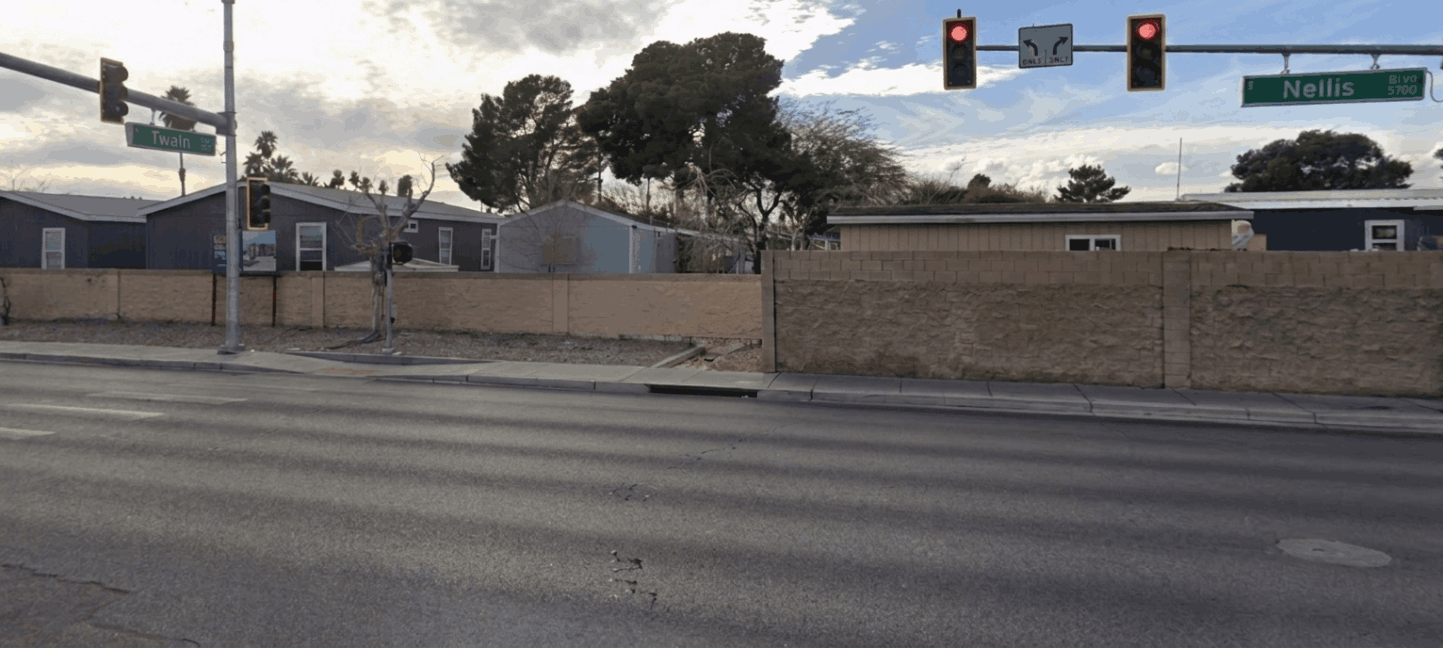
On the evening of August 23, 2026, a vehicle-versus-pedestrian hit-and-run collision occurred at South Nellis Boulevard and East Twain Avenue in Las Vegas, according to the Las Vegas Metropolitan Police Department (LVMPD). Evidence collected at the scene indicated that a pedestrian was crossing Nellis Boulevard, in an unknown direction, in or near the marked crosswalk, when an unknown gray sedan traveling southbound in the middle of three travel lanes entered the intersection and struck her, projecting her forward onto the roadway. The gray sedan did not remain at the scene. Arriving medical personnel transported the pedestrian, a 36-year-old woman, to Sunrise Hospital and Medical Center’s Trauma Center with life-threatening injuries. On August 24, 2026, a representative from the Clark County Office of the Coroner/Medical Examiner notified LVMPD’s Collision Investigation Section that the pedestrian had succumbed to her injuries at Sunrise Hospital. Her death marked the 80th traffic-related fatality in LVMPD’s jurisdiction for 2026. LVMPD has since located the silver 2005 Toyota Matrix involved in the collision, but the driver remains outstanding.
Based on these reported facts, a lawyer would examine several threshold issues: whether the pedestrian had the right-of-way in or near the crosswalk, what the striking vehicle’s lane position and speed may indicate about avoidability, and what evidence exists to identify the fleeing driver now that the vehicle itself has been recovered. Nevada follows a modified comparative negligence rule, meaning a person may recover damages if their share of fault is not greater than the combined fault of the parties being sued, though any recovery would be reduced by that person’s own percentage of fault. The collision remains under investigation, and final fault findings may depend on the full Metro report and preserved video.
Read the original report here.
Reported Details and What They May Mean for a Claim
According to LVMPD’s news release, the following facts have been reported so far:
- The collision occurred on South Nellis Boulevard at East Twain Avenue, a signalized intersection in east Las Vegas.
- The pedestrian was crossing Nellis Boulevard in an unknown direction, in or next to the marked crosswalk, when she was struck.
- The striking vehicle, described as an unknown gray sedan, was traveling southbound in the middle lane of three (T2) as it approached the intersection.
- The driver failed to remain at the scene and fled, an act LVMPD is investigating as a hit-and-run.
- Investigators expect the gray sedan to show front-end and windshield damage.
- LVMPD has since recovered the silver 2005 Toyota Matrix believed to be involved, though the driver has not been identified or located.
Because the striking vehicle has been located but the driver has not, a lawyer would likely prioritize a few investigative steps. Obtaining the police report and any supplemental findings early is a priority because it may contain witness statements, forensic vehicle-damage analysis, and the responding officer’s observations that can help establish how the pedestrian entered the roadway relative to the crosswalk. Preserving traffic camera or nearby business surveillance footage is also critical, since many Las Vegas intersections along Nellis Boulevard have cameras, but footage from private businesses is often overwritten within days. Registration and forensic evidence tied to the recovered Toyota Matrix, such as fingerprints, DNA, or cell-site data, may also help investigators determine who was driving at the time of the crash.
Hit-and-Run Collisions and Uninsured Motorist Coverage
A hit-and-run crash raises distinct insurance issues, particularly where, as reported here, the driver remains unidentified even after the vehicle was recovered. If the driver is never identified or is found to have no available liability coverage, the injured person’s own uninsured motorist (UM) coverage under NRS 690B.020 often becomes a central path to recovery. A lawyer would review all auto policies under which the pedestrian may qualify as an insured, including her own policy and any household-member policies, since Nevada law generally requires insurers to offer UM/UIM coverage unless it is rejected in writing.
Because the vehicle has now been located, a lawyer would also examine who owned the Toyota Matrix and whether that owner’s own liability policy could apply, depending on who was driving and whether that person had permission to use it. If the vehicle turns out to have been used without the owner’s permission or was reported stolen, that fact could affect which policies respond and may shift more weight onto the pedestrian’s own UM/UIM coverage. A lawyer would review whether any liability coverage may be available through the vehicle owner’s policy and whether UM/UIM coverage may apply if that coverage is denied or unavailable.
Pedestrian Right-of-Way and Fault Questions
Fatal pedestrian crashes often turn on right-of-way and lane-position questions that require careful factual development. LVMPD’s release states the pedestrian was crossing “in an unknown direction, in or next to the marked crosswalk,” which leaves open questions about whether she was fully within the marked crosswalk boundaries at the moment of impact. Nevada law generally requires drivers to exercise due care to avoid colliding with pedestrians, and drivers approaching a marked or unmarked crosswalk have specific yielding obligations under Nevada traffic statutes, though the precise application depends on facts still under investigation, including signal timing and each party’s exact position at impact.
A lawyer would also examine the striking vehicle’s reported lane position, the middle of three southbound travel lanes, since a driver in a center lane facing a longer, potentially less predictable approach to a pedestrian near a crosswalk may face additional scrutiny regarding lookout and reaction time. None of these observations establish fault; they identify the categories of evidence, such as signal-phase data, crosswalk striping, and any surveillance footage, that a lawyer would seek to develop a complete picture of how the collision occurred.
Fleeing the Scene and Potential Criminal Exposure
LVMPD’s release describes the driver as having “failed to remain at the collision scene” after striking the pedestrian, language consistent with Nevada’s duty-to-stop requirements following a crash involving injury or death. Leaving the scene of a crash involving death can carry serious criminal penalties in Nevada, separate from any civil liability. While criminal charges are handled independently by prosecutors, a lawyer evaluating a civil wrongful-death claim would monitor any criminal case against the driver once identified, since developments in that proceeding, including any plea or conviction, may later be relevant to the civil case.
Wrongful Death Claims Under Nevada Law
Because the pedestrian died from her injuries, her death may support a wrongful death claim under NRS 41.085, which allows a decedent’s heirs, often a spouse, children, or parents depending on family circumstances, to pursue certain damages. Recoverable damages in a Nevada wrongful death action may include medical expenses incurred before death, funeral and burial costs, lost future income and support, loss of companionship, and, depending on the claim’s structure, the grief and sorrow experienced by surviving family members. The statute of limitations for a wrongful death claim is generally two years from the date of death under NRS 11.190(4)(d), though a lawyer would confirm the applicable deadline based on the specific facts once the driver is identified.
Given that the driver is currently unidentified and the vehicle owner’s connection to the crash is still under investigation, a lawyer representing the family would likely need to balance evidence-preservation steps, such as sending preservation letters to nearby businesses for surveillance footage, against the practical reality that a civil claim against an unnamed defendant presents procedural challenges until LVMPD’s investigation identifies a suspect.
Nevada Personal Injury Legal Resources
People affected by fatal pedestrian hit-and-run crashes in Las Vegas or Clark County may have legal options worth evaluating, even when the driver has not yet been identified or when available insurance coverage is uncertain. In cases like this one, where the vehicle has been recovered but the driver remains outstanding, timing matters. Surveillance footage from nearby businesses, forensic evidence tied to the vehicle, and the final LVMPD investigative report can all be time-sensitive.
If you or a family member were involved in a similar accident in Las Vegas or Clark County, Nevada law may allow you to pursue a wrongful death or personal injury claim. Evidence, including surveillance footage, vehicle forensic findings, and the official crash report, can disappear or become harder to obtain as time passes. Speaking with a qualified Nevada personal injury attorney may be an important early step, particularly given evidence-preservation deadlines and statute-of-limitations issues.
The information in this article reflects laws and facts reported as of the date of publication. Nevada law may change. This article is for general informational purposes only and does not constitute legal advice. No attorney-client relationship is created by reading or sharing this content. If you have been injured in an accident, consult a qualified Nevada attorney for advice specific to your situation.
Leave a Reply