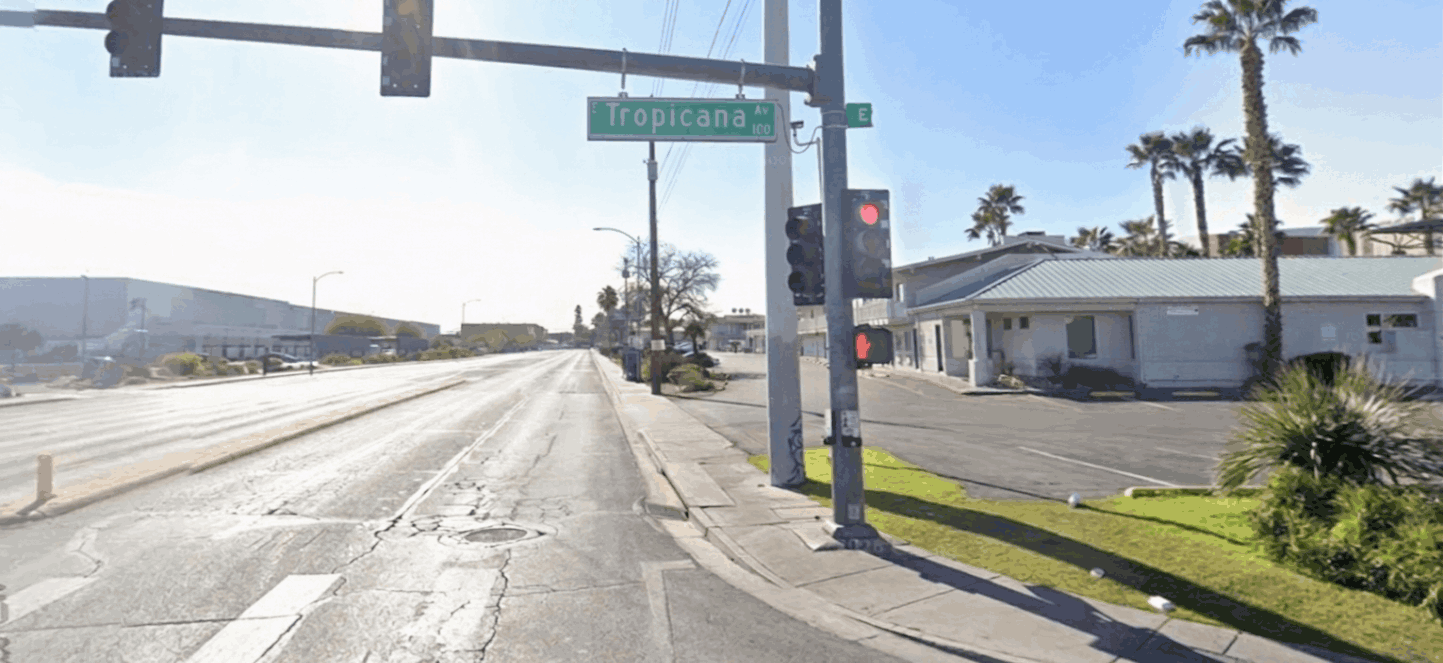
A pedestrian hit by an SUV on East Tropicana Avenue west of Koval Lane has died from his injuries, according to an update from the Las Vegas Metropolitan Police Department. The 45-year-old man was struck on the evening of August 2nd, 2026, while crossing Tropicana Avenue outside of a marked or unmarked crosswalk. He was hospitalized for over two weeks before succumbing to his injuries, and his death marks the 76th traffic-related fatality in LVMPD’s jurisdiction so far in 2026.
Because the pedestrian was reportedly crossing outside a crosswalk, this case raises a common but often misunderstood legal question: whether crossing mid-block or outside a designated crossing point automatically bars a pedestrian, or their family, from recovering damages. Under Nevada law, the answer is more nuanced than many people assume. Based on these reported facts, a lawyer would examine both the pedestrian’s positioning and the driver’s conduct before reaching any conclusion about fault.
Crash Overview and the Fatal Update
According to the Las Vegas Metropolitan Police Department’s press release update, the Clark County Office of the Coroner/Medical Examiner notified LVMPD’s Collision Investigation Section that the pedestrian succumbed to his injuries and was pronounced deceased at Sunrise Hospital. The original collision occurred on the evening of August 2nd, 2026, at approximately 8:08 p.m. on Tropicana Avenue west of Koval Lane. Evidence at the scene indicated a 2016 Land Rover Discovery was traveling eastbound on Tropicana Avenue when the pedestrian entered the roadway outside of a marked or implied crosswalk and into the vehicle’s path. The front of the Land Rover struck the man, projecting him onto the roadway. The driver, identified by police as 31-year-old Angel Gil-Molina of Henderson, remained at the scene and did not show signs of impairment, according to the release. The pedestrian was initially transported to UMC Hospital with what staff determined were life-threatening injuries. Additional reporting from the Las Vegas Sun confirms the man later died at Sunrise Hospital roughly two weeks after the crash.
From a legal-analysis standpoint, this crash sits at the intersection of two duties that Nevada law places on both pedestrians and drivers. Pedestrians crossing outside a crosswalk generally must yield the right-of-way to vehicles, but drivers still owe pedestrians a duty of due care regardless of where the pedestrian is crossing. The collision remains under investigation, and final fault findings may depend on the full Metro report and any preserved video, including footage from nearby businesses along the busy Tropicana Avenue and Koval Lane corridor.
Read the original report here.
Reported Details and What They May Mean for a Claim
- Vehicle-versus-pedestrian collision on Tropicana Avenue west of Koval Lane, in the evening on August 2nd, 2026
- A 2016 Land Rover Discovery was traveling eastbound when the pedestrian entered the roadway outside a marked or implied crosswalk
- The pedestrian, a 45-year-old man, suffered life-threatening injuries and was later pronounced deceased at Sunrise Hospital
- The driver, identified as Angel Gil-Molina, 31, of Henderson, remained at the scene and did not show signs of impairment, according to police
- The death is the 76th traffic-related fatality in LVMPD’s jurisdiction for 2026, according to the department’s update
- The collision remains under investigation by LVMPD’s Collision Investigation Section
Preliminary news reports may not contain final police findings. A lawyer would seek the official Las Vegas Metro crash report for more complete details, including the precise distance from the nearest crosswalk, lighting conditions at the time, and any measurements or timing data collected at the scene.
These facts may indicate a case where comparative fault becomes central to any legal analysis. A lawyer would investigate whether the driver was traveling at a safe speed, using headlights appropriately for the evening hours, and had a reasonable opportunity to see and react to the pedestrian. A lawyer would also examine the exact distance between the crash location and the nearest marked or unmarked crosswalk, since Nevada law treats intersections differently depending on whether a crosswalk exists there, marked or not.
Important evidence in a case like this often includes the police crash report, 911 and dispatch recordings, scene photographs, witness statements, medical records documenting the pedestrian’s treatment and eventual death, and any traffic or business camera footage from the Tropicana Avenue and Koval Lane corridor, which sits in a heavily trafficked area near the Las Vegas Strip. Because the driver remained at the scene and reportedly showed no signs of impairment, a lawyer would focus less on intoxication and more on issues like speed, reaction time, and visibility.
What Nevada Law May Mean for a Pedestrian Struck Outside a Crosswalk
Investigators will determine the exact cause of this crash. The following is a general overview of how Nevada law may apply to this type of accident.
Pedestrian Right-of-Way Outside a Crosswalk
Under NRS 484B.287, a pedestrian crossing a roadway at any point other than within a marked crosswalk or an unmarked crosswalk at an intersection generally must yield the right-of-way to vehicles. That rule may weigh against the pedestrian’s position in this case, since police describe him as crossing outside of a marked or implied crosswalk. However, yielding the right-of-way is not the only duty involved. Drivers generally owe pedestrians a duty of due care under NRS 484B.280 regardless of where the pedestrian is located, and that duty does not disappear simply because a pedestrian is crossing mid-block.
Comparative Negligence and How Fault May Be Divided
Nevada follows a modified comparative negligence rule under NRS 41.141. Generally, an injured person, or in a wrongful death case the decedent’s survivors, may recover damages so long as the pedestrian’s own negligence was not greater than the negligence attributed to the driver. If a court or insurer determines the pedestrian was 50 percent or less at fault for crossing outside the crosswalk, a claim may still proceed, though any recovery would be reduced by that percentage. A lawyer would examine facts such as lighting, vehicle speed, and whether the driver had a reasonable opportunity to avoid the pedestrian before concluding how fault might be apportioned.
Wrongful Death Considerations
Because the pedestrian died from his injuries, Nevada’s wrongful death statute, NRS 41.085, may become relevant to any claim brought by his surviving family members. A wrongful death claim generally requires showing that the driver’s negligence contributed to the death, and the same comparative-fault analysis that would apply to a personal injury claim would likely apply here as well. The fact that the pedestrian died approximately two weeks after the collision, rather than at the scene, does not change the underlying legal analysis, though it may affect the scope of medical damages considered as part of any claim.
Driver Conduct and What a Lawyer Would Examine
Police reported that the driver remained at the scene and did not show signs of impairment. That fact may reduce certain lines of inquiry, such as DUI-related claims, but it does not resolve the broader question of whether the driver was traveling at an appropriate speed, watching the roadway attentively, or reacted appropriately once the pedestrian entered the roadway. A lawyer would examine the vehicle’s speed at impact, any available Event Data Recorder information from the 2016 Land Rover Discovery, and witness accounts of how much time the driver had to react.
How a Lawyer May Investigate a Pedestrian Fatality Outside a Crosswalk
Serious pedestrian crashes that later turn fatal usually require a fast, thorough legal investigation, particularly where comparative fault is likely to be disputed.
- Obtain the Las Vegas Metro crash report. This is often the first priority because it may contain measurements of the exact crossing location relative to the nearest crosswalk, the responding officer’s observations, and any citations issued to either party.
- Preserve nearby traffic and business surveillance footage. Tropicana Avenue near Koval Lane is close to major resort corridors, and nearby hotels, businesses, or traffic cameras may have captured the moments before the crash. Footage is often overwritten quickly, so a lawyer would act fast by sending preservation letters to any business or agency that may have relevant recordings.
- Collect the vehicle’s Event Data Recorder (black box) data. Many modern vehicles, including the 2016 Land Rover Discovery involved here, may record speed and braking input in the seconds before a crash, which can help establish whether the driver had a reasonable opportunity to avoid the pedestrian.
- Interview witnesses promptly. Witness memories fade quickly, and in this case witnesses may help establish lighting conditions, the pedestrian’s visibility, and how much warning the driver had.
- Document the full medical timeline. Because the pedestrian survived for roughly two weeks before dying, a lawyer would gather complete medical records from both UMC Hospital and Sunrise Hospital to document the course of treatment and cause of death.
- Evaluate available insurance coverage. A lawyer would review the driver’s liability policy limits and determine whether the family’s own coverage, if any, could supplement a recovery depending on how fault is ultimately apportioned.
A lawyer would use this evidence to assess how fault might be divided between the pedestrian and the driver under Nevada’s comparative negligence framework, and to determine whether the facts support a wrongful death claim under NRS 41.085. Because the pedestrian was reportedly crossing outside a crosswalk, the strength of any claim would likely depend heavily on what the investigation reveals about the driver’s speed, attentiveness, and opportunity to avoid the collision.
What Families Should Know After a Pedestrian Fatality
Families dealing with a loss like this often face significant uncertainty about whether a claim is even possible when the pedestrian was not in a crosswalk. It is important to understand that crossing outside a crosswalk does not automatically eliminate a family’s legal options. Nevada’s comparative negligence system means fault is often shared, and the driver’s conduct matters just as much as the pedestrian’s positioning.
Nevada’s statute of limitations generally gives survivors a limited window to pursue claims. Under NRS 11.190, wrongful death claims generally carry a two-year deadline, which for this case would run from the August 2026 date of the underlying collision rather than the later date of death, though a lawyer would confirm the applicable accrual date under current Nevada law. Missing this deadline may permanently bar recovery, even where liability might otherwise be shared.
An attorney may help families gather crash-scene evidence before it disappears, evaluate what insurance coverage may apply, and assess how comparative fault issues might affect the value of a claim. Because pedestrian fatality cases outside crosswalks often turn on detailed factual questions about speed, lighting, and reaction time, early investigation can matter significantly to the outcome.
Nevada Personal Injury Legal Resources
Pedestrian fatalities involving crossings outside marked crosswalks raise legal questions that many families assume are already decided against them. That assumption is often incorrect under Nevada’s comparative negligence framework, which allows recovery so long as the pedestrian was not more than 50 percent at fault. Families of pedestrians struck outside crosswalks, like the man involved in this Tropicana Avenue collision, may still have legal options worth evaluating, particularly where a driver’s speed, attentiveness, or reaction time is in question.
If you or a family member were involved in a similar accident in Las Vegas or Clark County, Nevada law may allow you to pursue a wrongful death claim even where the pedestrian was crossing outside a marked crosswalk. Evidence, including surveillance footage and the official crash report, can disappear or become unavailable quickly. Speaking with a qualified Nevada personal injury attorney may be an important early step.
The information in this article reflects laws and facts reported as of the date of publication. Nevada law may change. This article is for general informational purposes only and does not constitute legal advice. No attorney-client relationship is created by reading or sharing this content. If you have been injured in an accident, consult a qualified Nevada attorney for advice specific to your situation.
Leave a Reply